You don't need to be selling anything to want an answer to this. An insurer will ask eventually. A family member will ask sooner. And some quiet evening you'll do the math yourself and want it to be right, not a guess anchored to whatever the newest bottle cost.
This is a guide to estimating what a whiskey collection is actually worth — not a guide to selling it, and not investment advice. Just a way to put a real number, or a real range, on a shelf.
Why value matters even if you never sell
Three reasons come up more than any others. Insurance is the biggest: a standard homeowner's or renters policy typically caps alcohol at a few hundred dollars, nowhere near what a shelf of allocated bottles is worth, and a rider needs a real number to be written against. Estates are the second — whoever inherits a collection needs to know if they're looking at a nice shelf or a genuinely valuable one, and that's a conversation easier to have in writing than after the fact. And the third is simpler: trading and gifting go better when both sides know roughly what's changing hands, even in a hobby built on generosity.
None of this requires treating the shelf as a portfolio. It requires an honest number you can point to.
Retail vs secondary reality
MSRP is close to fiction for anything allocated. A bottle that lists at $50 can trade for three or four times that the moment it's hard to find, and a bottle that lists at $150 can sit at a store for a year at that exact price if nobody's chasing it. The gap isn't a scandal — it's just supply and demand doing what they do — but it means the number on the shelf tag is rarely the number that matters for valuation.
The useful distinction is retail price versus secondary-market price. Retail is what a store charges when it can get the bottle to you at all. Secondary is what someone actually paid for it most recently, in a store or a legal marketplace, when the two don't have to be the same number. For an everyday pour, they usually are. For anything allocated, limited, or discontinued, only the secondary number tells you what the bottle is worth today.
How to comp a bottle
“Comp” is just short for comparable — what did a bottle like this one actually sell for, recently, to a real buyer. It's the same idea appraisers use for houses and collectors use for anything else with no fixed price.
Two sources do most of the work. Completed auction results from a reputable specialist auction house show real hammer prices, not asking prices — look at the last several sales of the same bottle, not just one outlier. And marketplace listings on legitimate secondary platforms show what sellers are currently asking, which is a softer signal but useful for anything too new or too obscure to have auction history yet.
Condition changes the number more than most people expect. Fill level matters — a bottle poured down below the shoulder is worth meaningfully less than one still at the neck, even with the same label. So does the box: a bottle with its original box, and any extras it shipped with, consistently comps higher than the same bottle bare. Label condition — tears, staining, sun-fading — matters too, the same way it would on a book or a print. When you're comping your own bottle, compare against sales in similar condition, not just the same name.
A caution on selling
This guide is about knowing what a collection is worth, not a how-to for selling it. Private resale of alcohol is regulated, and the rules vary widely by state and country — some places allow licensed secondary sales, many don't allow private sales at all, and getting it wrong carries real legal risk. If you're considering selling, check your local law and use a properly licensed platform or auction house. That part of the process is genuinely outside the scope of what we can advise on here.
Keeping values current
A value is a snapshot, not a fact. Bottles that were rising two years ago plateau, bottles nobody wanted suddenly get chased, and a number you typed in once goes stale in both directions without you noticing. Revisiting values once a year — not obsessively, just annually — keeps an insurance rider honest and keeps you from over- or under-stating what's on the shelf.
Documentation matters as much as the number itself. A dated photo of the bottle and its box, and the receipt or a note of what you paid, are what an insurer or an estate actually wants to see — the estimate is only as credible as what backs it up. If you're building that record from scratch, our guide to cataloging a collection covers the fields worth keeping, including price paid and estimated value side by side so you can see the gap without losing the history.
The app shortcut
Re-pricing a shelf by hand, bottle by bottle, is exactly the kind of upkeep that gets skipped after the first year. In Whiskey Thief, market value estimate (a Pro feature) gives you a current best-effort estimate of what a bottle might be worth today, right next to what you paid for it — phrased as an estimate, because that's what it is.
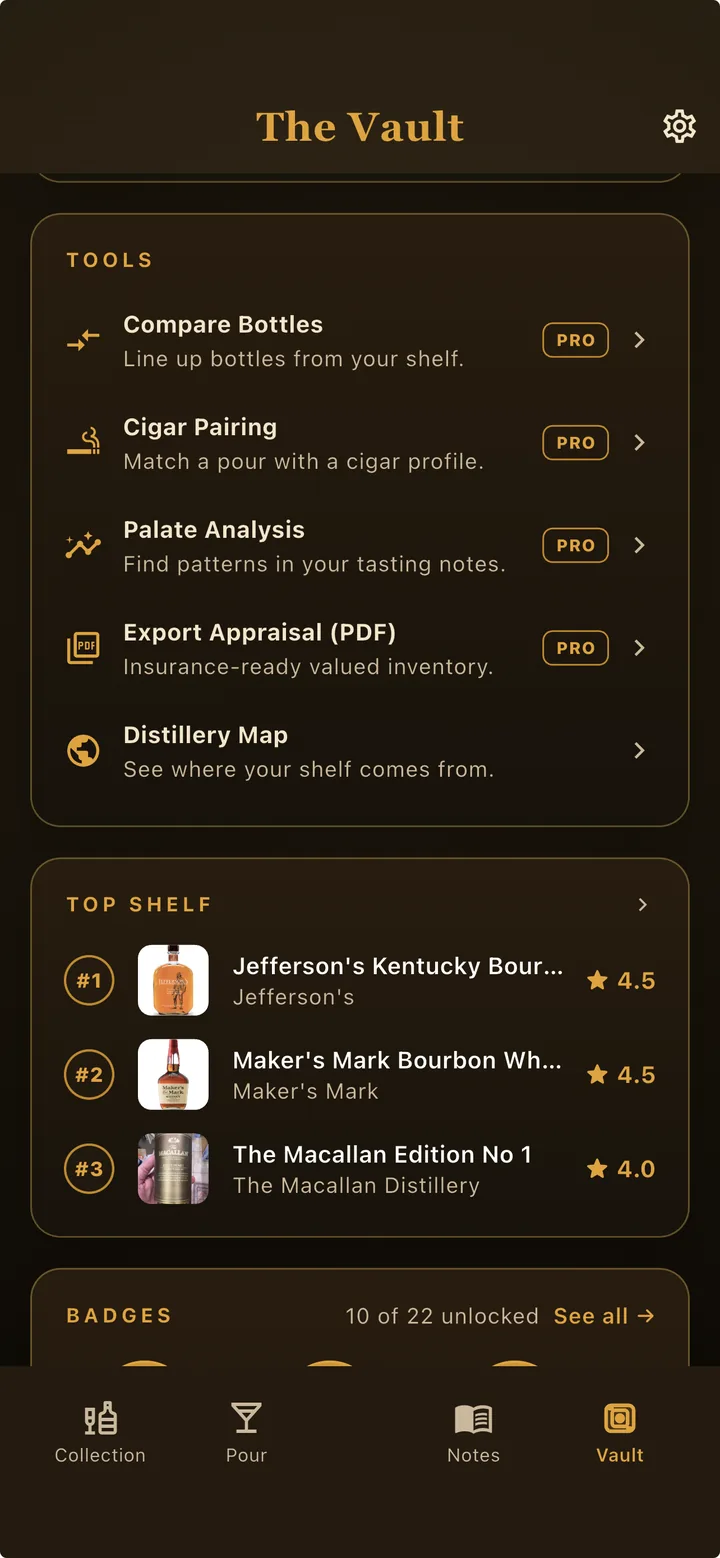
The shelf view rolls those estimates into a running collection total, so the question “what's this worth right now” has an answer without a spreadsheet session. The core journal is free (here's everything included); the estimate itself, along with palate analysis, compare bottles, and Shelf Check, is Pro. And because the whole collection lives on your phone rather than a server, the private whiskey journal with an AI palate — your collection never leaves your phone.