Somewhere in every collector's journal there's an entry that just says “excellent.” You wrote it in complete confidence — the pour was right there in the glass, what more could you possibly need? Eighteen months later the bottle is gone, the store shelf is offering you the new batch at a higher price, and “excellent” tells you exactly nothing.
This is a guide to writing tasting notes that survive: five fields that take about ninety seconds a pour, a way to build a vocabulary that's actually yours, and the mistakes that quietly ruin good notes — plus a free printable tasting sheet near the bottom, if you'd rather start tonight on paper.
Why notes fade
A score without words means nothing in six months. The score recorded how much you liked a whiskey; it never recorded what you liked about it. Half a year on, the number is still sitting there and the pour behind it is gone — you end up rating your own rating, trying to reverse-engineer a memory out of a digit.
Memory doesn't just fade, either; it edits. The bottle that got hard to find starts tasting better in hindsight. The one a friend talked down quietly loses a point. Words written while the glass was still warm are the only witness that can't be talked out of its story.
So the standard for a good tasting note isn't “reads like a magazine review.” It's narrower and more personal: a year from now, does it put the glass back in your hand? Notes that pass that test share one habit — they're specific. “Fruity” fades. “Baked apple and old leather” doesn't.
The five fields
Nose, palate, finish — every tasting note has heard of those three. The two that get skipped, proof and setting, are the ones that make the other three comparable across your shelf. Here's each field in practice, with the kind of notes worth writing.
Nose
Let the pour sit a few minutes, then come at it slowly — nose just above the rim, lips slightly parted, short sniffs. Charge straight in and all you'll record is ethanol. Then write what's actually there, not what's supposed to be there:
- “Baked apple and old leather, something floral underneath — honeysuckle, maybe.”
- “Vanilla frosting on the first pass; ten minutes in the glass turned it into toasted marshmallow.”
- “New sneakers and orange peel. Not flattering, but I'd know this whiskey blindfolded now.”
That third kind of note earns its keep. Odd, even unflattering smells are often the most recognizable thing about a bottle — write them down without apology.
Palate
The first sip is a calibration; your mouth is still adjusting to the proof, and nearly everything reads as heat. The real note starts on the second sip. Hold it a moment, let it cover your tongue, and give texture equal billing with flavor:
- “Thin up front, then black tea and toasted pecan arrive mid-palate.”
- “Syrupy — coats the teeth. Brown sugar sliding into cinnamon-stick spice.”
- “Rye bite first, then it turns soft: dark chocolate and a little cherry cough drop.”
Notice those notes have an order — first this, then that. A palate is a sequence, not a list, and the sequence is usually the part you'll want back later.
Finish
The finish is two questions: how long, and what's left? Swallow, breathe out slowly, and time what happens. This is also where a whiskey most often betrays its one flaw, so honesty pays:
- “Short and clean — faint mint, gone in under a minute.”
- “Long drying oak that turns faintly bitter at the very end. The bottle's only flaw.”
- “The smoke shows up here and nowhere else — campfire on the exhale.”
Proof and dilution
The first forgotten field. Write the label proof, then what you actually did to the pour — neat, two drops of water, a splash, one big cube. A barrel-proof whiskey tasted neat and the same whiskey over ice are close to different drinks, and a note that doesn't say which one you met can't be trusted later. This field also captures one of tasting's small pleasures: “124.8 proof, neat — hot enough that the fruit hides. Two drops of water and the heat stepped aside for peach cobbler.” That's one bottle, two honest notes, and a house rule for how you'll pour it from now on.
Setting
The second forgotten field, and the one that explains your outliers. Where were you, who was across the table, what had you just eaten? “Back porch, first cool night of October, cigar half done” and “hotel room, exhausted, plastic cup” will score the same whiskey differently, and neither note is lying. Record the spicy dinner that flattened everything and the head cold that stole your nose. When a beloved bottle inexplicably disappoints later, setting is usually the field holding the answer.
Building a vocabulary
Nobody starts out smelling honeysuckle. The way in is a ladder from general to specific: name the broad family first, then climb a rung when you can. Fruit → orchard fruit → baked apple. Sweet → caramel → the scorched edge of a crème brûlée. Spice → baking spice → cinnamon stick, the kind that's been in the jar a while. On a given night you climb as far as the pour and your patience allow — “orchard fruit” is a perfectly good note, and a rung you can honestly stand on beats a rung you copied from someone else.
Two rules keep the ladder honest. Never write a word you don't actually mean — one true “cherry” is worth ten decorative ones. And your own references beat borrowed vocabulary every time: “the inside of my grandfather's toolbox” is a better note than any term you looked up, because it will still mean something to you in five years.
A flavor wheel — broad families around the hub, specifics out at the rim — is this same ladder drawn as a picture, and a genuinely useful thing to keep near the glasses. The wheel deserves a proper walkthrough of its own, so we'll give it one in a future guide.
Common mistakes
Copying the label. The back label is marketing copy, written before you ever met the bottle. If your note says “notes of vanilla, caramel, and oak” and so does the label, you tasted the label. The fix is easy: write your note first, then read the label and enjoy the argument.
Scoring without describing. The mistake this whole guide exists to prevent. A score plus even one specific line — “the cherry cough drop one” — will outlive a bare score by years. If you only have ten seconds, skip the score and keep the line.
Tasting too cold, too fast. Cold mutes exactly the things you're trying to record; a bottle from a chilly cabinet needs a few minutes to wake up, and a good pour deserves them. Speed does the same damage — a note scribbled off the first sip is a note about burn. Let the glass sit, revisit, and write the second impression. Some of the best notes end with “…and completely different an hour later.”
The printable tasting sheet
Everything above fits on one page — we made sure of it. Print a stack, leave them near the good glasses, and hand spares to whoever's pouring with you.
Free printable: Whiskey Tasting Sheet (PDF) One page, print-friendly. Nose, palate, finish, proof, and setting — the same fields collectors keep in Whiskey Thief.No signup, no watermark across the writing space — just the sheet. It doubles as a score sheet if you're hosting a tasting night.
How Whiskey Thief helps
Paper is a lovely way to taste and a terrible way to remember — sheets pile up, and the one you want is never the one you find. That's the job we built Whiskey Thief for: it's the private whiskey journal with an AI palate — your collection never leaves your phone. The in-app tasting sheet keeps the same five fields you just practiced — nose, palate, finish, proof, setting — attached to the bottle they belong to, so the note about the October porch pour is right there the next time that bottle comes up.
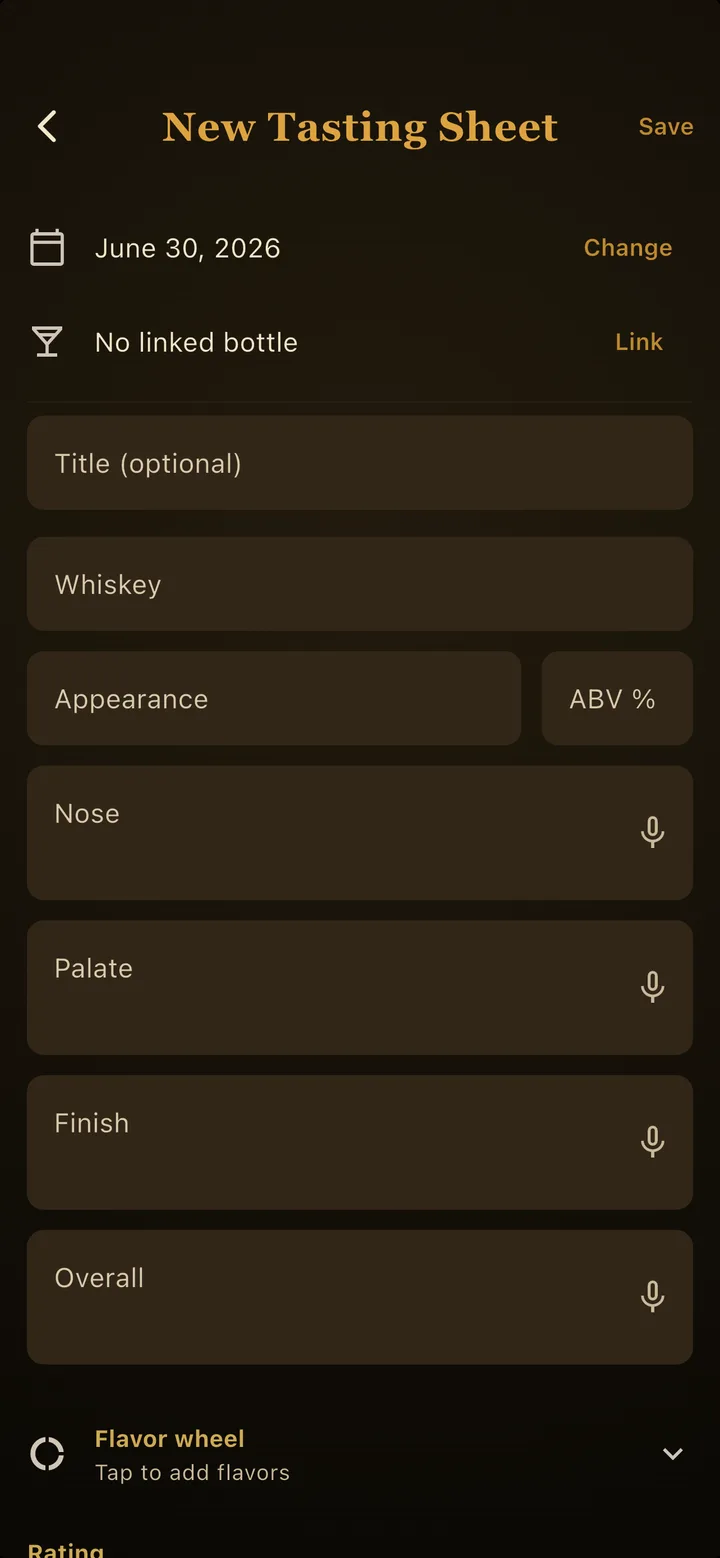
The core journal — shelf, tasting notes and sheets, wish lists — is free (here's everything included). And for the nights the glass is in one hand and the words won't come, the tasting-note assist, a Pro feature, offers a starting set of notes for any pour, ready to refine — a first rung on the ladder, with your palate doing the editing.
However you keep them — paper sheet, app, battered notebook — the rule is the same: write the note while the glass is still warm. If you go the app route, the user guide walks through the journal screen by screen.