The difference between “come over, I'll open something good” and a tasting night people talk about for months is not the bottles. It's structure — a reason the pours are in the order they're in, glasses that don't fight the whiskey, and some way of remembering what everyone thought before the evening blurs.
None of that has to be fussy. Here's the playbook: how to build a flight, what to put on the table, why order matters more than people expect, whether to run it blind, and how to keep the night once it's over.
Pick the flight
A flight needs a theme, and the theme is what turns four pours into an argument worth having. Three that reliably work:
- A vertical. One distillery, several expressions — entry-level, the mid-shelf, the cask-strength one. Everyone tastes the house style emerge, and the differences stop being abstract.
- One style, many hands. Four wheated bourbons from four distilleries, or four Speysiders. This is the flight that teaches people what they actually like, because the variable is the maker, not the category.
- Price-blind. A $30 bottle, a $60, a $120, and something allocated — poured blind. This one is genuinely fun and occasionally humbling, and it produces the best conversation of any format I've run.
Four to six pours is the range. Below four there's nothing to compare; above six, palates give out and the last pour gets a rating it didn't earn. Pour half an ounce to an ounce each — small on purpose. A six-pour flight at one ounce is already six ounces of whiskey per person, which is more than it sounds like when it's all cask strength.
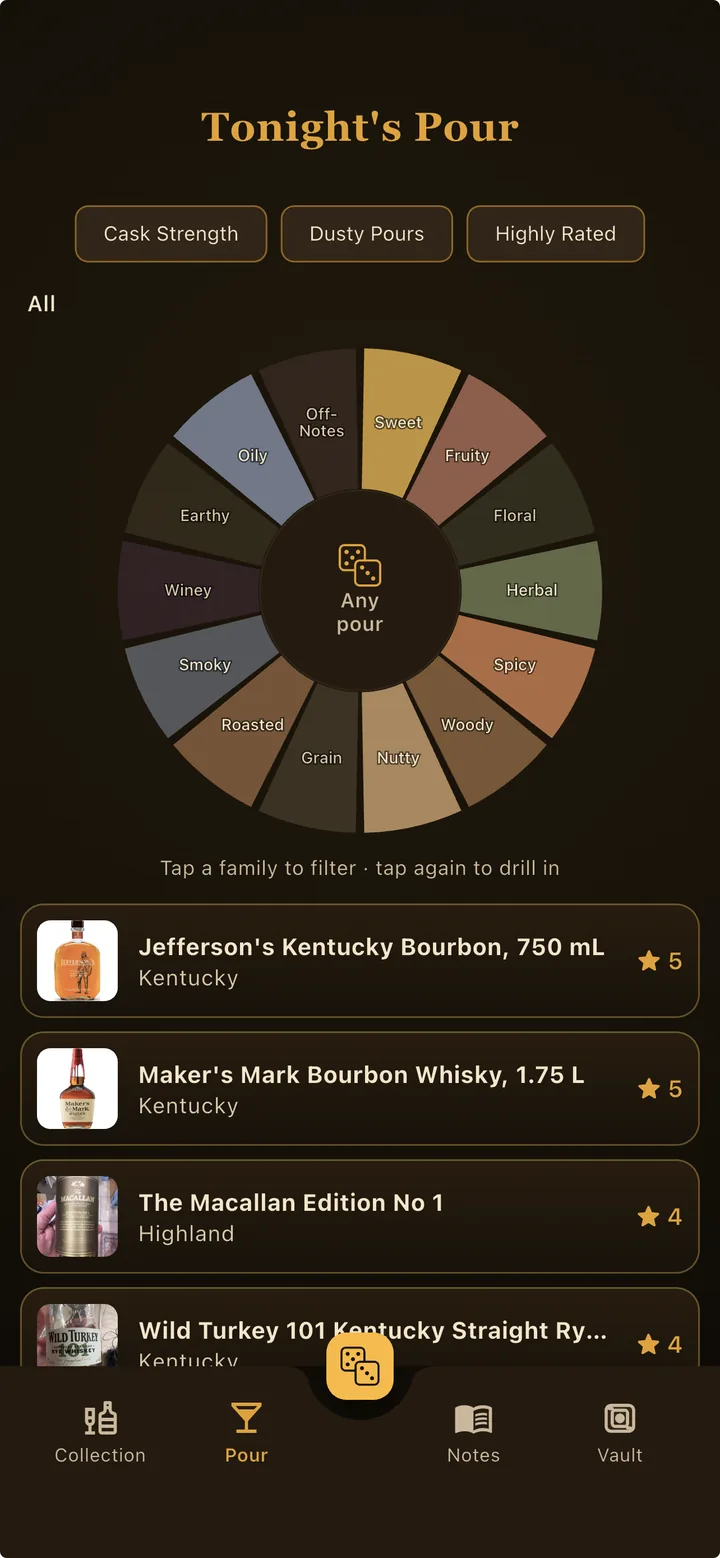
If the shelf is deep enough that picking four bottles is the hard part, this is exactly what the Pour wheel in Whiskey Thief is for — filter your own collection by flavor family, or by cask strength and highly-rated, and build the flight from what you already own.
Set the table
Glencairns if you have them, any tulip-shaped glass if you don't — the narrowed rim is doing real work, concentrating the nose instead of letting it escape across a wide surface. Rocks glasses are for drinking, not tasting. If you're short, thrift a set; nobody needs matching crystal.
What else goes on the table: still water, both for drinking and for adding a drop or two to a high-proof pour. Plain crackers or plain bread as a palate reset. A pen at every seat. And a spit or dump cup, which sounds joyless until the fourth pour, when the person who's been finishing every glass has stopped being able to tell you anything useful.
What doesn't go on the table: anything with a strong smell. Scented candles, a cheese board, someone's cologne, garlic in the kitchen. You are asking six people to make fine distinctions with their noses, and the room is either helping or it isn't.
Order matters
Go up in proof, not down. Start with the lowest-proof pour and climb — open with the 120-proof barrel pick and everything after it tastes like water, because your palate has been reset at a level the rest of the flight can't reach.
The same logic puts the assertive stuff last. Anything peated goes at the end, full stop; smoke lingers in the glass, on the palate, and in the room. So do heavy finishes — sherry, port, anything sweet and dominating. If your flight has one bottle that's clearly the loudest voice, it goes last regardless of proof.
Between pours, a sip of water and thirty seconds of not-drinking does more than any elaborate palate cleanser. And announce the order at the start, or don't — which brings us to the interesting question.
Run it blind (or don't)
Blind tasting is the single biggest upgrade you can make to a tasting night, and it costs nothing. Label knowledge changes what people taste — not because anyone's being dishonest, but because that's how tasting works. Show someone a famous bottle and they will find complexity in it.
The method is simple: wrap each bottle in foil or a paper bag, number them, and pour out of sight if you can. Everyone tastes and writes before anyone speaks — this part matters more than the wrapping. One confident person saying “that's obviously the sherry cask” before the notes are down will pull the whole table with them.
Then the reveal, one at a time, after everyone has committed to paper. The reveal is the whole payoff: the moment the $35 bottle turns out to be the table favorite, or somebody's most-hyped grail lands fourth out of five. Run a price-blind flight this way once and you'll never go back.
Not every night needs it. A vertical is often better open — you want people tracking the house style deliberately. But if you're picking one format to try, try blind.
Score sheets
Give people something to write on. Not because scores matter — they mostly don't — but because writing forces attention, and because the sheets are what makes the reveal work. A table that has committed its notes to paper has something real to compare against the labels.
Ours is free, one page, print one per guest per pour or let people number down the sheet:
Free printable: Whiskey Tasting Sheet (PDF) One page, print-friendly. Nose, palate, finish, proof, and setting — the same fields collectors keep in Whiskey Thief.If your guests have never written a tasting note before, point them at our guide to writing notes you'll actually reread beforehand — or just tell them the rule that matters: describe before you score. “Baked apple and old leather, short finish” is worth something in six months. “7/10” is worth nothing.
Keep the night
Here's the part almost everyone skips. The sheets get collected, put somewhere, and thrown out three weeks later during a kitchen tidy — and the whole evening's worth of reactions goes with them.
Log the flight before the glasses are washed. Not everything: the bottle, one line of what you thought, and one line of what the table thought, which is often the more interesting record. Two minutes while people are still putting coats on. If you wait for the morning, the specifics are already gone and you'll be reconstructing a consensus that never existed.
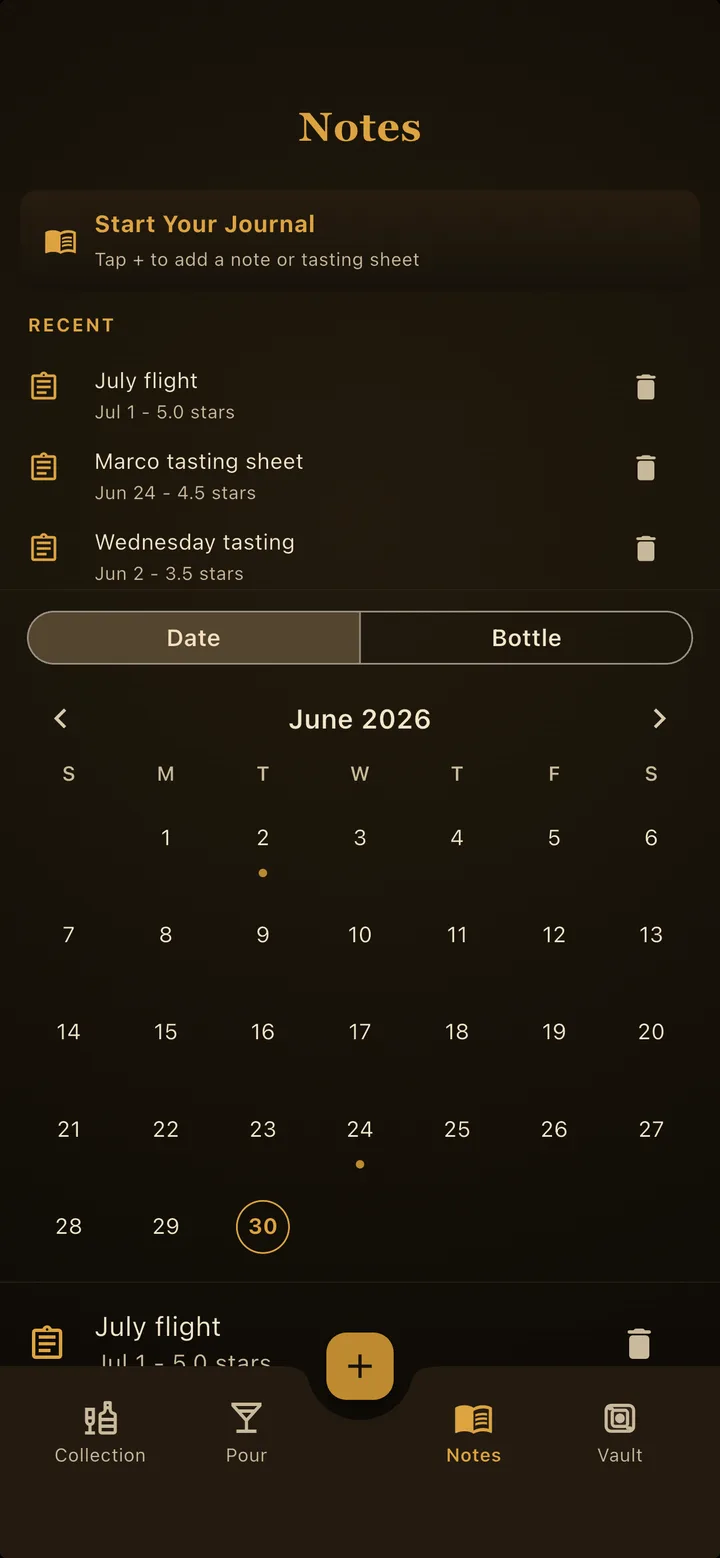
For the group thread afterward, export a bottle card — a clean image of the pour to send around, without handing anyone your notes. Share the pour, keep the notes. The journal stays yours: Whiskey Thief is the private whiskey journal with an AI palate — your collection never leaves your phone, and there's no feed and no account for anyone to browse.
The core journal — shelf, tasting notes, flights — is free (here's everything included). Once you've logged a few nights, the Pro tools start earning their keep: palate analysis reads your own notes back to you and names the tendencies you didn't know you had, and compare bottles puts two pours side by side after the fact.
One last thing, and it's the host's job: small pours, water on the table, and nobody drives who shouldn't. A tasting night is about paying attention, and that's a lot easier at half an ounce a glass than at three fingers.